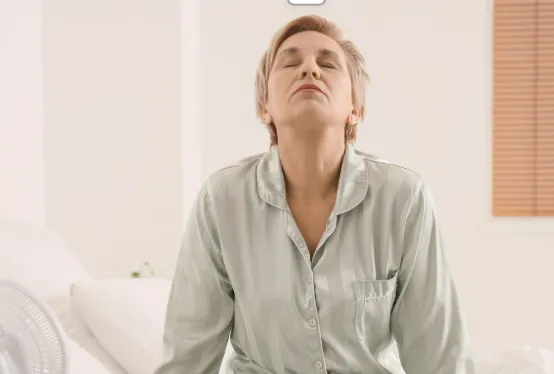
What If You’re Not Losing Your Mind?
It’s okay to not be okay.
I want to start there — not because it’s the kind of thing wellness coaches are supposed to say in May, but because Mental Health Awareness Month is one of the few openings we have all year to actually mean it.
If you are not okay right now, you are not alone. You are not weak. You are not failing. You are a human being living through a hard season — and sometimes the season is genuinely hard.
Sometimes hard means we need help.
And here is something I want to say out loud before I say anything else, because I do not want this post to be misread:
There is nothing wrong with medication.
If you are on an antidepressant, an anti-anxiety, a sleep aid — anything at all that is helping you function, helping you sleep, helping you breathe through the day — please hear me clearly. That is not a failure. It is not weakness. It is not the absence of doing “real” work.
Sometimes a prescription is the very thing that creates enough breathing room for a woman to begin the deeper work she actually needs to do. Sometimes it is the floor that lets her stop falling long enough to see where she is. Sometimes it is medically necessary, full stop.
All of that is valid.
This post is not about whether to take medication.
It is about a conversation almost no one is having underneath it.
She came to me already on three prescriptions. She had been to her doctor twice in the last six months — bloodwork normal, thyroid fine. The medication was helping her sleep, sort of. It was helping her get through the day, mostly.
And still, something inside her was quietly certain that the actual thing was being missed.
She was 49.
Many women in their 40s and 50s are experiencing what looks like a mental health crisis when what is actually moving through them is perimenopause and menopause. Or — and this is the more nuanced version — they have a real underlying experience of anxiety, depression, or overwhelm that is being amplified, surfaced, and sharpened by the hormonal and identity shift of midlife.
The conventional system rarely has time to tell the difference.
So she gets the prescription. The prescription helps her function — which is sometimes exactly what she needs.
But underneath the symptom, there is often a message her body has been trying to send her for a very long time. And in the rush to manage the symptom, that message can go unreceived.
Both layers can be true at once.
“Your symptoms are real. And they are not the problem.”
Here is what I have learned working with women in their 40s and 50s.
When a midlife woman begins experiencing what looks like depression, anxiety, panic, insomnia, rage, or a profound, unfamiliar disconnection from her own life — it is rarely random.
It is rarely “just chemistry.”
It is almost always her body finally refusing to keep performing the version of life she has been white-knuckling through for two decades.
The hormonal shift of menopause does not create the disconnection.
It just turns the lights on.
It removes the neurological coping mechanisms that made the over-functioning feel sustainable. The buffering goes away. And suddenly she is left in a body that will no longer let her push through, override, or perform around the truths she has been quietly suppressing.
What presents as a mental health crisis is often the most accurate signal her body has ever sent her.
This is the work of the Reclaim Pathway — and specifically of Pillar 2: Reconnection over Fixing.
The high-performing woman in midlife approaches her own distress the way she approaches every other problem in her life. Diagnose it. Research it. Fix it.
But she is not a problem.
She is a person whose body has been quietly trying to tell her something for a very long time — and has finally gotten loud enough to be heard.
The work is not to silence the symptom.
The work is to listen to it.
What listening looks like in my hands
I am a Master Practitioner of NLP, trained in Mental and Emotional Release® and Release Point Method™ — modalities specifically designed to help women release decades of stored emotional content without having to relive the pain to do it, and without relying on willpower.
What that means in practice:
We do not bypass what she is feeling.
We also do not require her to climb back inside it.
The work is to release the emotional charge underneath the symptom — the anger, fear, sadness, guilt, hurt, and the limiting decisions her body has been carrying on her behalf for years. So the message her body has been trying to deliver finally gets through. So the symptom no longer has to keep delivering it.
It is the place where her nervous system finally gets to put down what it has been holding.
And what was being labeled anxiety, depression, or burnout often loses its grip in the process — not because the symptom was fake, but because the message has finally been heard.
So if this is you — if no one has handed you a label, if you have not been to a doctor, but you have been running through your own symptoms in your head at 3am
The unfamiliar heaviness.
The anxiety no one has named for you.
The loss of purpose that arrived without warning.
The slow, electric pull to implode a twenty-year marriage. To quit the job that once filled your cup. To run. To blow up a life you have spent decades carefully holding together.
~please hear me.
You are not losing your mind.
You are not broken.
You may simply be the woman who has finally gotten quiet enough to hear what her body and her life have been trying to tell her for a very long time.
Your symptoms are real.
And they may also be telling you the truth about a life that was not built for the woman you are becoming.
You may be waking up — inside a body that is no longer willing to anesthetize the very thing it has been trying to bring to your attention.
This is not a mental health crisis.
This is a homecoming, dressed in difficult clothing.
A note before I close
If you are in genuine mental health crisis — if you feel not safe, if the darkness has gone deep ~ please reach out to a clinician you trust. What I am describing here is not a substitute for medical care. It is a layer underneath it.
For the woman who is asking, in the back of her own mind, what if this isn’t really anxiety? What if this is something else entirely? —
You are not the only one asking.
And you are likely much closer to the truth than you have been allowed to believe
— Dina